The Problem: AI Tools Aren't Enough
Many organizations have equipped developers with powerful AI tools like GitHub Copilot, expecting a revolution in productivity. However, this boost to *individual* productivity often fails to translate into a tangible *organizational* impact on development velocity or quality.
[WHY IT'S FAILING]
- Lack of a holistic organizational strategy.
- Underestimation of the deep cultural change required.
- Immature processes and bottlenecks that AI simply accelerates into.
[THE SOLUTION]
We don't just need new tools; we need a new framework. A model that integrates AI as a core collaborator, redefines team structures, and re-engineers the entire development lifecycle.
Pillar 1: The Hyperproductive Team
The new fundamental unit of value is a small, elite 3-person team that orchestrates a [Generative AI Core]. This structure maximizes human strategic input and AI execution output.
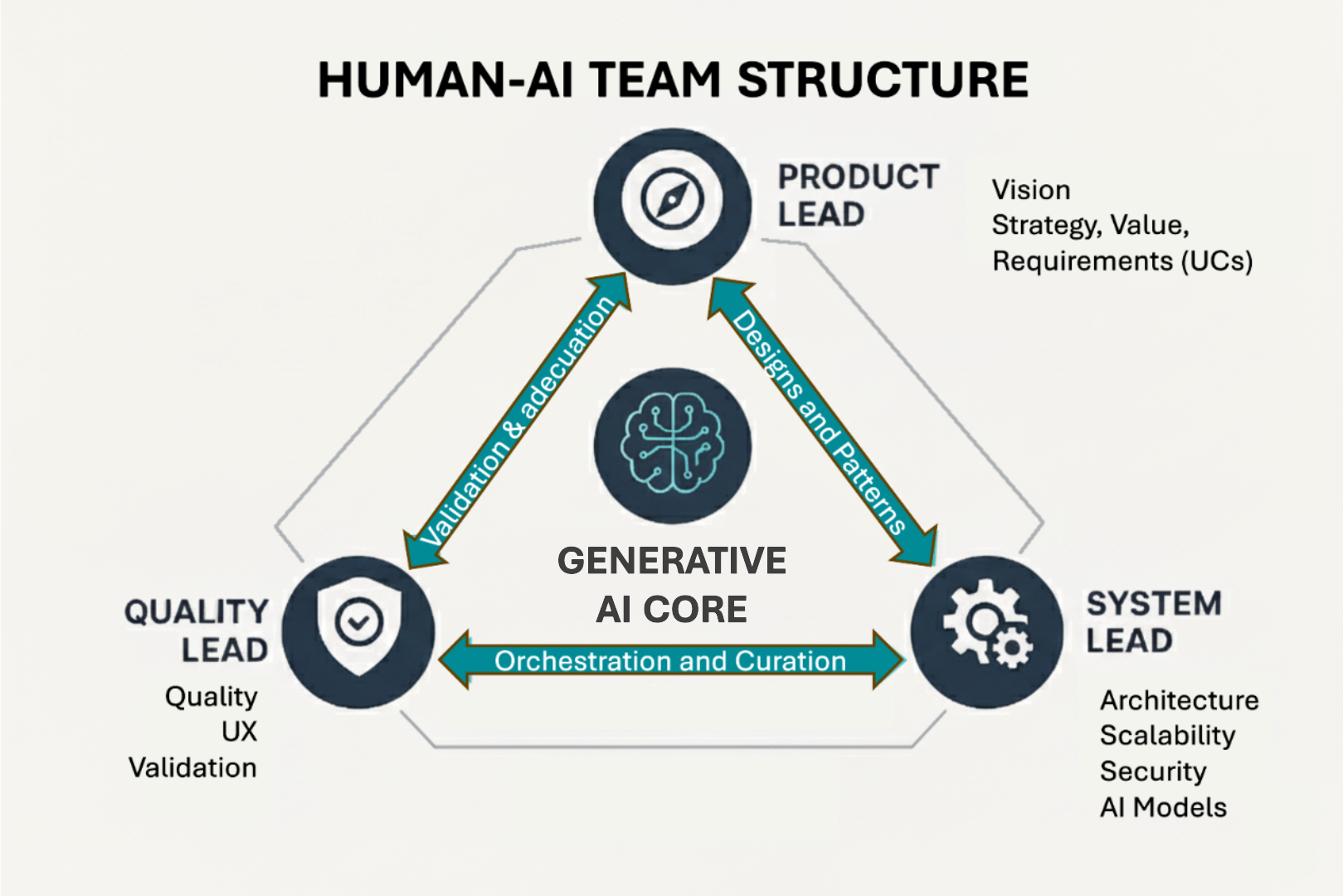

Product Lead
[The Visionary]
- ► Defines product vision & strategy.
- ► Master of strategic prompt engineering.
- ► Manages prioritization and value.
- ► Co-designs high-level solutions with AI.

System Lead
[The Technical Guarantor]
- ► Defines and supervises architecture.
- ► Integrates and optimizes the AI toolchain.
- ► Performs deep technical validation of AI code.
- ► Governs data, models, and security.

Quality Lead
[The User Defender]
- ► Designs and orchestrates AI testing strategies.
- ► Validates UX with critical human judgment.
- ► Performs strategic exploratory testing.
- ► Manages feedback and continuous quality.
Pillar 2: The 24-Hour Operating Cycle
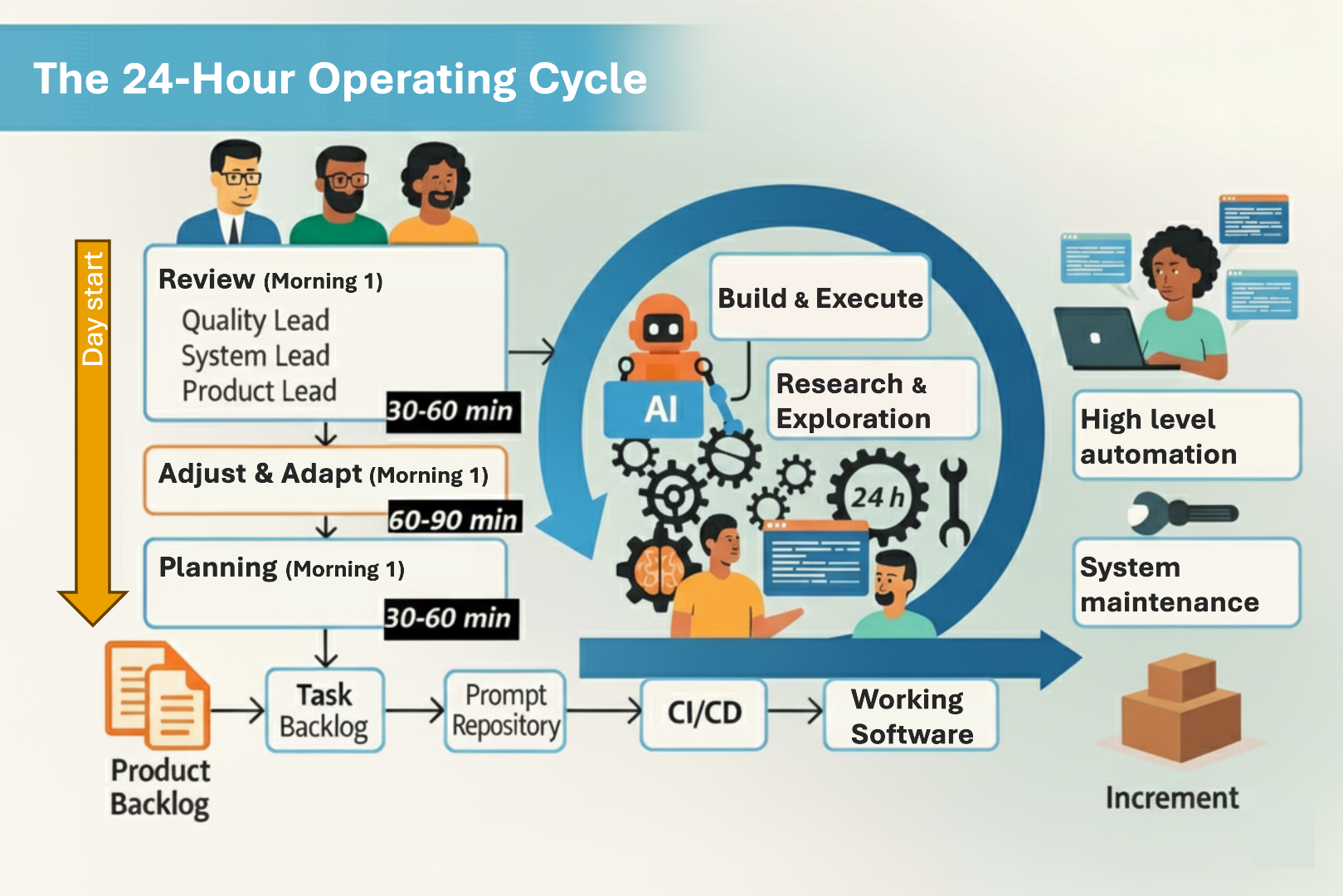
This team operates in an ultra-fast "Daily Sprint." The cycle is designed to maximize human strategic time and leverage AI for 24/7 execution.
-
1. Review (Morning: 30-60 min)
The team inspects the Product Increment from the previous 24h AI execution. The Quality Lead leads the review, the System Lead evaluates technical integrity, and the Product Lead verifies value alignment.
-
2. Adjust & Adapt (Morning: 60-90 min)
The team analyzes problems and, crucially, refines and optimizes the prompts in the [Prompt Repository]. This is how the team "teaches" and tunes its AI collaborators for the next cycle.
-
3. Planning (Morning: 30-60 min)
The Product Lead selects high-value items from the Product Backlog. The team breaks them down into detailed tasks and prompts for the Task Backlog, defining the AI's objectives for the day.
-
4. Build & Execute (24 Hours)
AI agents take over, working unattended to generate code, run tests, and perform analyses. This frees the human team for high-value strategic work: backlog refinement, research, and exploring new AI tools.
Risks & How to Start
Key Risks to Manage
- AI Hallucinations: Plausible but incorrect outputs that require human critical judgment.
- Skill Degradation: Over-reliance on AI can atrophy core human problem-solving skills.
- Human Burnout: The human roles are high-stakes and cognitively demanding. The 24h cycle is for the AI, not the people.
How to Begin the Transformation
- Start with Pilots: Deploy strategic pilot projects (both greenfield and brownfield) to face real-world challenges.
- A/B Challenging: Run new "hyperproductive cells" against traditional teams and *measure everything* (value delivery, quality, team health).
- Measure & Adapt: Focus on metrics for Product Value, Flow Efficiency, and Team Sustainability.